For many equipment appraisers, determining value is only part of the job. Before the analysis can begin, someone has to find the market evidence.
That can mean searching auction results, equipment marketplaces, dealer listings, search engines, and other sources for assets similar to the subject. Once a potential comparable is found, the appraiser still needs to review it, document it, capture supporting evidence, record the specifications, organize the files, and connect that information back to the correct subject asset.
On an appraisal with dozens—or hundreds—of assets, those small tasks add up quickly. So where does the time actually go during equipment appraisal comparable research?
Comparable Research Is More Than Searching for a Sale
It is easy to think of comparable research as simply searching for similar equipment online. In practice, the workflow is much larger.
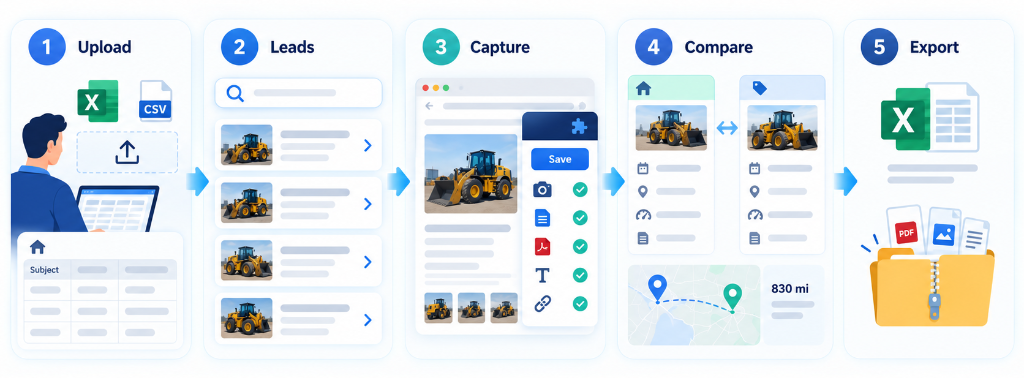
Each individual step may only take a few minutes. The problem is repetition.
If an appraisal contains 50 subject assets and an appraiser evaluates several potential comparables for each asset, the same research and documentation process may be repeated hundreds of times.
Price Chant was developed around this exact workflow problem: comparable research traditionally requires appraisers to search multiple websites, review potential comps, preserve supporting evidence, manually transfer specifications, organize files, and reconcile that information later in the appraisal process.
Where Does the Time Go?
The time spent researching equipment comps generally falls into several stages across the assignment lifecycle.
1. Preparing the Subject Assets
Before searching for comparables, the appraiser needs to understand what is being valued. Depending on the assignment, useful subject information might include:
- Manufacturer, make, and model
- Year of manufacture
- Serial number or VIN
- Meter hours or odometer mileage
- Configuration, boom/stick setup, or package options
- Condition rating and maintenance history
- Engine make, model, and emissions tier
- Fuel type (diesel, electric, hybrid, gas)
- Operating capacity and payload weight
- Subject location and operating climate
- Asset-specific attachments, tooling, or aftermarket additions
The more complete the subject information is, the easier it becomes to construct useful searches and evaluate potential comparable sales.
But large appraisal projects create another challenge: keeping all of that information organized. An equipment appraisal may contain dozens or hundreds of individual assets, each requiring its own research trail.
2. Searching for Potential Comparable Sales
This is the most obvious part of the process. An appraiser may search auction houses, historical auction databases, equipment marketplaces, dealer websites, eBay, Craigslist, general search engines, and other publicly available market sources.
Auction results are especially useful because completed auction sales can provide evidence of actual market transactions rather than asking prices alone. However, depending on the equipment and assignment, other market sources may also provide relevant evidence. Price Chant is designed to support research across this broader range of sources rather than treating comparable research as a single-site search.
The challenge is that the first search rarely produces the final comp. An appraiser might try combinations such as:
- 2019 CAT 259D auction results
- CAT 259D skid steer sold
- 2018 2019 2020 Caterpillar 259D auction
- CAT 259D 2,000 hours sale price
Different terminology, model variations, configurations, years, and specifications can all affect the results. And every search result still has to be reviewed.
3. Evaluating Whether a Result Is Actually Comparable
Finding equipment for sale is not the same as finding a good comparable. A potential comp may have the same model number but differ significantly in:
- Year and series generation
- Operating hours or mileage
- Physical and mechanical condition
- Cab and hydraulic configuration
- Included attachments or work tools
- Engine horsepower and tier compliance
- Rated lifting or operating capacity
- Geographic location and local market dynamics
- Sale type (unreserved auction, retail asking, dealer wholesale)
- Transaction date relative to the valuation effective date
"Technology can help discover potential leads, but the appraiser still determines whether a sale is sufficiently comparable to provide meaningful market evidence."
That distinction is important. Price Chant treats search results as leads, not automatically accepted comps. The appraiser reviews the lead and decides whether the characteristics and sale information make it appropriate for comparison with the subject asset.
This review process often represents a significant amount of research time because many search results ultimately will not be used.
4. Documenting the Comparable
Finding a strong comp is only half the job. The appraiser also needs to preserve the evidence. That may involve:
- Recording the source URL and capture date
- Saving listing photos and condition documentation
- Taking full-page or viewport screenshots
- Printing or saving the webpage as an archival PDF
- Recording the auction house, marketplace, or dealer name
- Saving realized sale dates and lot numbers
- Recording sale prices and buyer's premium structures
- Capturing verified equipment specifications
- Adding notes explaining the comparability rationale
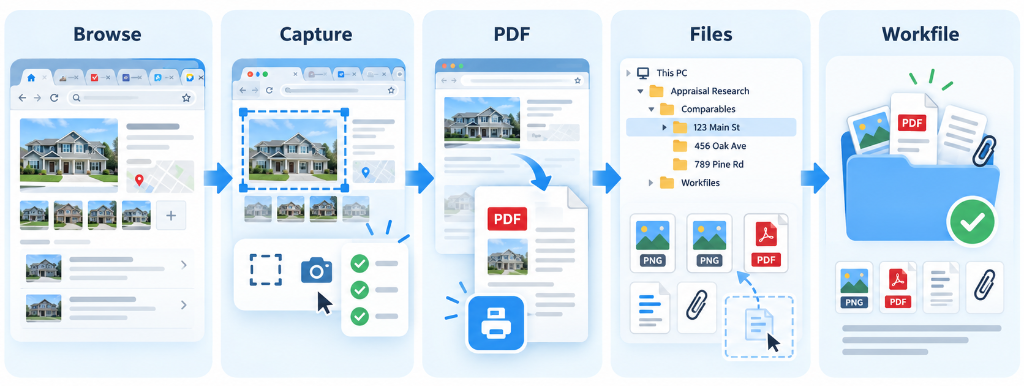
This documentation supports the appraisal workfile and allows the comparable to be reviewed later. The problem is that documentation interrupts the research process.
An appraiser may find a useful auction result, switch to a spreadsheet, enter several fields, return to the browser, take a screenshot, save a PDF, rename the file, place it into the correct project folder, and then return to searching. Multiply that process across dozens of comps and the administrative burden becomes substantial.
5. Transferring Comparable Specifications
Comparable listings often contain valuable information beyond the sale price, including make, model, year, hours, mileage, VIN, engine, fuel type, capacity, transmission, trim, and location.
Traditionally, much of this information is copied manually from the source listing into an appraisal spreadsheet or database. That creates two problems:
- First, it takes substantial time that could be spent on valuation analysis.
- Second, repetitive manual data entry creates opportunities for mistakes: mistyped serial numbers, mismatched hours, or associating specs with the wrong subject row.
The more assets involved in an appraisal, the more difficult it becomes to keep everything synchronized.
6. Researching Additional Specifications
Sometimes the original listing does not contain everything the appraiser needs. Additional research may be required to identify vehicle specifications, engine characteristics, GVWR class, manufacturing information, trim packages, configurations, or other technical characteristics.
Vehicle appraisals may involve VIN decoding, while specialized equipment may require manufacturer documentation or additional web research. Each additional lookup adds another small task to the project. Again, the problem is rarely one lookup — it is performing the same lookup repeatedly across many assets.
7. Evaluating Geographic Differences
Location can also affect the relevance of a comparable. An equipment sale located 30 miles from the subject may represent a different market situation than one located 2,000 miles away.
That means appraisers may need to identify the subject location, the comparable location, calculate the distance between them, assess potential regional market differences, and consider freight and mobilization costs.
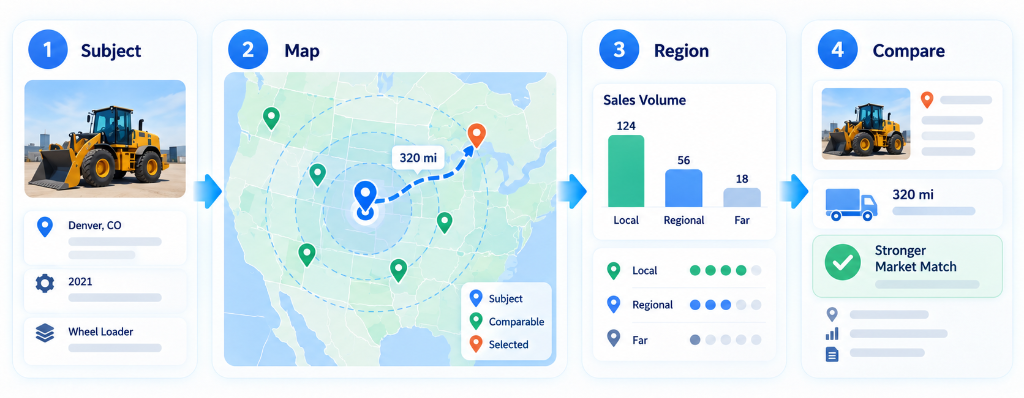
Price Chant treats geographic distance as another comparable characteristic and can calculate the approximate distance between a subject and comp when adequate location information is available. Without an integrated system, even something as simple as checking distance can mean opening another browser tab, searching both locations, recording the mileage, and returning to the appraisal spreadsheet.
8. Organizing Everything Later
One of the biggest hidden costs in appraisal research often appears after the research has already been completed. The appraiser may now have:
- A subject spreadsheet and a comparable spreadsheet
- Screenshots, PDFs, and downloaded auction images
- Browser bookmarks, history entries, and URLs
- Handwritten scratchpads and separate local folder trees
Now everything has to be matched back together: Which screenshot belongs to which comparable? Which comparable belongs to which subject? Was that auction result ultimately used? Where was the PDF saved? Did the spreadsheet get updated?
This organizational work does not necessarily improve the valuation analysis itself. It is simply necessary to maintain a usable appraisal workfile.
The Real Cost Is Repetition
Comparable research contains many tasks that seem insignificant individually. Opening another tab might take seconds. Saving a screenshot takes seconds. Copying a specification might take seconds. Renaming a PDF might take seconds. But appraisal projects operate at scale.
That is why improving the appraisal research workflow can have such a large impact. The goal is not necessarily to make the appraiser research faster — it is to remove unnecessary steps surrounding the research.
What Parts of Comparable Research Can Be Automated?
This is where appraisal technology can help. Certain parts of the workflow still require professional judgment. An appraiser should determine whether a comparable is appropriate. But many surrounding tasks are procedural:
- Generating potential comparable leads across multiple search engines and marketplaces
- Capturing webpages, screenshots, and complete PDF evidence archives
- Collecting webpage text and extracting machine-readable specifications
- Organizing comparable data into structured, consistent schemas
- Decoding VIN and equipment serial numbers automatically
- Calculating geographic distances between subject and comp locations
- Connecting comps directly with subject assets
- Exporting research into structured, audit-ready workfiles
These are the kinds of repetitive tasks that can increasingly be handled through appraisal research software.
How Price Chant Approaches Comparable Research
Price Chant is designed as an appraisal research workflow and evidence-management system, rather than simply a search engine. The workflow begins by importing the subject assets being appraised.
From there, an appraiser can generate potential comparable leads using multiple research systems, including Google Search, ChatGPT web search, Gemini web search, and Perplexity.
Once the appraiser finds a useful comparable, the Price Chant browser extension can capture the source webpage, including a screenshot, PDF copy, webpage text, and source information.
Price Chant can then use AI to identify information from the captured page and map those characteristics against fields associated with the subject asset. The appraiser reviews the extracted information and remains responsible for deciding whether the comparable is appropriate.
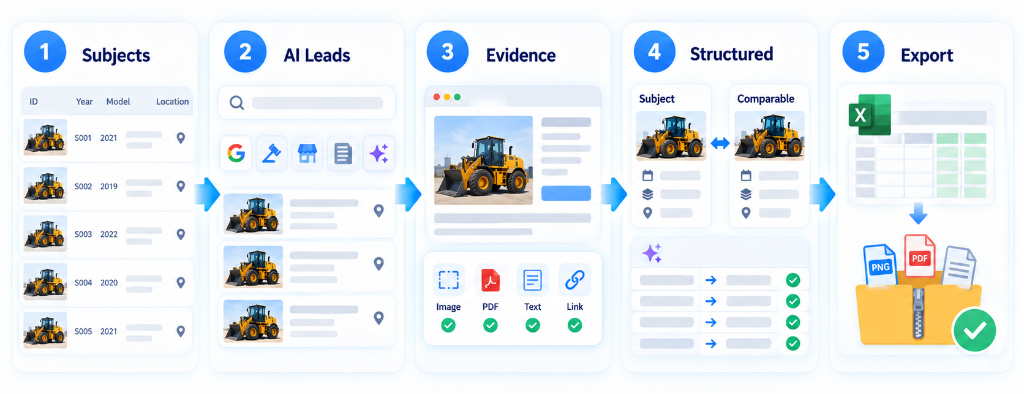
Instead of spreading the research across spreadsheets, browser tabs, screenshots, folders, and bookmarks, the intended workflow keeps the information connected throughout the entire appraisal engagement.
Spend More Time Analyzing the Market
Comparable research will always be an important part of an equipment appraisal. The objective should not be to eliminate research — the objective is to reduce the repetitive work surrounding it.
Appraisers still need to understand the equipment, evaluate the market, determine whether a comparable is relevant, reconcile differences, and develop a supported opinion of value. Those are professional appraisal decisions.
- Copying specifications between browser tabs and spreadsheets is not.
- Saving screenshots one at a time is not.
- Renaming dozens of PDFs is not.
- Recalculating distances manually is not.
The more of that administrative work that can be streamlined, the more time the appraiser can devote to the part of the assignment that actually requires appraisal expertise.
Price Chant was built around that idea: helping appraisers spend less time collecting and organizing comparable evidence and more time analyzing that evidence and completing the appraisal.
Pull defensible comps, keep the reasoning tight, and ship the workfile faster.
Explore solutions