Equipment Comparable Sales: A Guide for Appraisers
Where do equipment appraisers find comparable sales, and how do they determine whether the market evidence is genuinely useful? This comprehensive reference guide teaches personal property, machinery, and equipment valuers how to discover, screen, evaluate, and verify comparable sales across diverse market channels.
What Is an Equipment Comparable Sale?
In machinery, equipment, vehicle, and personal property appraisal, a comparable sale is verifiable market evidence of a completed transaction or active offering for an asset sharing similar utility, production capacity, mechanical specifications, and commercial appeal to the subject asset being valued.
Defined by physical inspection, documented serial numbers, verified operating hours, maintenance condition, and installed options.
Evaluated across utility, capacity, condition, geography, and transaction terms.
Recorded auction hammer results, verified dealer transactions, or active retail offerings reflecting observable buyer and seller actions.
Equipment appraisers do not hunt for an impossible exact duplicate. In dynamic machinery markets, identical machines with matching hours, attachments, and maintenance histories rarely exist. A valid comparable is simply relevant market evidence whose similarities and differences can be logically analyzed and reconciled relative to the subject asset.
Lead vs. Comparable: The 4-Stage Qualification Funnel
One of the most frequent mistakes in valuation research is assuming that every online listing or auction record found during an initial search is an accepted comparable. In professional appraisal practice, a discovered listing is merely a candidate lead until qualified through appraiser review.
Search Result
Raw webpage hits, auction catalog listings, and marketplace search cards returned from web queries.
Potential Lead
A machine matching the subject's general class, manufacturer, or approximate production vintage that warrants closer inspection.
Appraiser Review
The appraiser examines transaction terms, confirms arm's-length status, checks meter hours, inspects photos, and validates specifications.
Selected Comparable
Vetted, defensible market evidence accepted into the formal appraisal workfile to support value conclusion.
Finding an equipment listing or auction lot does not make it a valid comparable. The appraiser must review the evidence, screen out non-arm's length terms, confirm whether the reported price was a cleared sale or an asking price, and decide whether the machine is sufficiently relevant to the subject.
Where Equipment Comparable Sales Come From
Equipment markets are fragmented across multiple distribution tiers. No single database captures every transaction. Professional appraisers synthesize evidence across six primary market channels:
Completed Auctions
Public auction houses (Ritchie Bros., IronPlanet, Sullivan, Alex Lyon, EquipmentFacts) provide verifiable clearing prices under open bidding conditions.
Retail Dealer Networks
Franchised OEM dealerships and independent machinery dealers publish listed inventory reflecting current commercial equipment availability.
Equipment Marketplaces
Aggregated platforms (MachineryTrader, Equipment Trader, Rock & Dirt, Commercial Truck Trader) showcase thousands of regional dealer and broker listings.
Private-Party Market Data
Publicly available direct seller classifieds or documented corporate equipment dispersals where terms can be substantiated.
eBay & Specialized Exchanges
Online bidding archives for light construction equipment, attachments, machine shop tooling, commercial vans, and precision implements.
Brokers & Liquidation Sales
Direct transactions through industrial machinery brokers, corporate restructurings, bankruptcy trustees, and orderly liquidation events.
The Market Evidence Spectrum
Different sources provide different levels of evidentiary certainty. An appraiser must recognize where each data point falls along this spectrum:
Unreserved auctions, documented private closings, and settled liquidations. Provides empirical proof that consideration exchanged hands at that price.
Dealer confidential trade-in reports, historical listings with documented delist dates, and verified equipment appraisal surveys.
Dealer lot listings, classified ads, and online marketplaces. Reflects seller aspirations and current availability; does not prove a closed sale.
Understand what the reported price represents before relying on it in an appraisal. Never cite an asking price as a confirmed transaction price, and always verify whether auction records include or exclude buyer premiums.
Sold Price vs. Asking Price: Why the Distinction Is Critical
In real estate, closed sale registries are publicly recorded in county deeds. In personal property and equipment valuation, no universal deed registry exists. This makes distinguishing between completed sales and asking prices one of the most critical responsibilities of an equipment appraiser.
Completed Sale Evidence
Evidence that an actual exchange of consideration occurred between a buyer and seller under documented commercial conditions.
- Evidentiary Weight: Primary empirical baseline for the Sales Comparison Approach.
- Transaction Terms: Clear sale date, hammer amount, buyer premium, and payment clearing terms.
- Defensibility: Withstands audit and litigation scrutiny because a willing buyer actually paid that price.
Asking Price Listing
The initial price at which a dealer or private seller offers an asset to the market—representing an upper bound, negotiation anchor, or hope price.
- Evidentiary Weight: Establishes upper-bound retail availability and ceiling of value, not cleared value.
- Built-in Margin: Often includes 10% to 25% dealer margin, inspection overhead, and negotiation buffer.
- Defensibility Risk: Treating an untested asking price as a cleared sale violates appraisal standards.
An asking price should not automatically be treated as a completed-sale price. Furthermore, appraisers must avoid inventing universal adjustment rules (such as casually applying a flat "10% discount for cash") without market corroboration. Asking prices demonstrate market supply and upper bounds—not consummated transaction value.
The 12 Dimensions of Equipment Comparability
How does an appraiser determine whether candidate market evidence is sufficiently relevant? Rather than relying on guesswork, accredited personal property valuers evaluate 12 distinct dimensions:
Make & Manufacturer
Premium global OEMs (Caterpillar, Komatsu, John Deere) maintain stronger secondary market demand and parts availability compared to regional or budget manufacturers.
Model & Series Generation
Series suffixes (e.g., Cat 320 GC vs. 320 vs. 320 DL) represent major variances in hydraulic flow rates, engine displacement, electronic control packages, and duty cycle design.
Year & Chronological Age
A machine's vintage must be evaluated alongside regulatory emissions shifts (e.g., Tier 4 Final transitions), electronic guidance capabilities, and structural upgrades.
Operating Hours & Mileage
Hours consumed directly indicate wear on internal engines, pumps, transmissions, and undercarriages relative to the machine's total economic useful life (EUL).
Physical & Mechanical Condition
Undercarriage wear percentage, hydraulic cylinder pitting, engine blowby, structural weld repairs, and cosmetic cab preservation heavily dictate real-world market appeal.
Configuration & Chassis Setup
Long stick vs. standard stick, high-flow auxiliary circuits, enclosed ROPS/FOPS with climate control, and wide track pads differentiate operating versatility.
Capacity & Operating Specs
Gross operating weight, flywheel horsepower, maximum bucket payload, and breakout force establish the baseline physical production capability of the asset.
Attachments & High-Value Tooling
Installed high-value attachments (e.g., $25,000 hydraulic hammers, integrated 3D GPS machine control systems) must be isolated or adjusted in line-item comparisons.
Sale Date & Market Conditions
Macro interest rate cycles, fuel costs, construction activity, and supply-chain equipment backlogs create significant price shifts between different transaction quarters.
Geographic Location & Freight
Heavy equipment is freight-sensitive. Hauling an oversize excavator 800 miles requires heavy-haul lowboys and pilot cars, creating direct geographic price variances.
Transaction Type & Level of Trade
Wholesale unreserved auction clearance, dealer retail with warranty, orderly plant liquidation, and distressed bank repossession represent fundamentally distinct pricing levels.
Source Quality & Verifiability
Credible comps require primary transaction proof: clear lot photographs, verified serial numbers, inspection certificates, and documented seller identity.
Subject Asset vs. Candidate Comparable: Side-by-Side Analysis
Consider a typical appraisal assignment evaluating a 20-ton hydraulic excavator. Here is how an appraiser structures the side-by-side comparison with candidate market evidence:
| Characteristic | Subject Machine (Target) | Candidate Comparable A | Appraiser Observation |
|---|---|---|---|
| Make | Caterpillar | Caterpillar | Exact Match |
| Model & Series | 320 (Next Gen) | 320 (Next Gen) | Exact Hydraulic Platform |
| Year of Mfr. | 2021 | 2020 | 1 Year Older (-1 Vintage Year) |
| Operating Hours | 3,200 Hours | 4,100 Hours | +900 Hours (~1 Heavy Season) |
| Condition Rating | Good (Undercarriage 65%) | Good (Undercarriage 60%) | Comparable Wear Pattern |
| Auxiliary Hydraulics | Dual-function high-flow | Dual-function high-flow | Exact Match |
| Location | Sacramento, CA | Reno, NV | 135 Miles Freight Distance (I-80 Corridor) |
| Transaction Type | — | Sold (Regional Unreserved Auction) | Verified Arm's-Length Transaction |
| Reported Amount | Subject to Value | $148,000 Hammer | Baseline empirical transaction datum |
Identical chassis generation and factory hydraulic circuitry ensure identical operating capacity and commercial appeal.
Comp A has 900 more hours, is one year older, and sold in Reno, requiring regional freight and wear consideration.
The appraiser concludes Comp A is highly relevant. In the subsequent valuation approach, the appraiser determines whether adjustments are necessary.
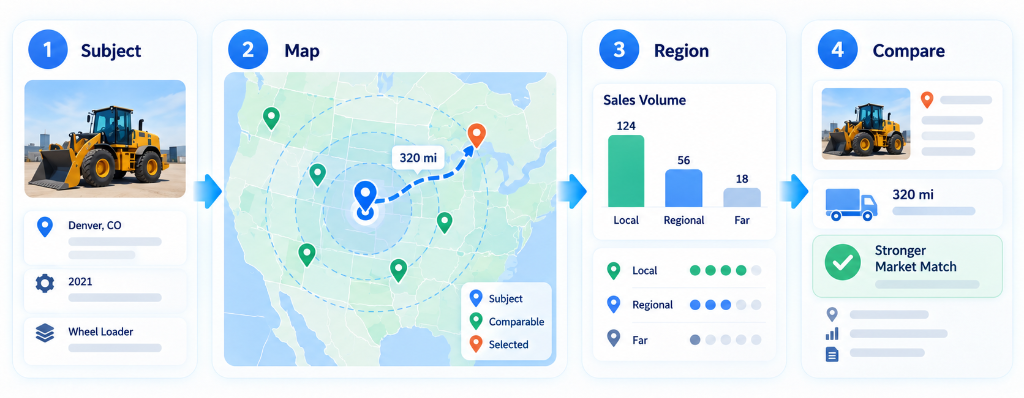
Geographic Comparability: Freight, Regional Demand & Climate
Unlike securities or financial instruments, machinery and physical personal property are constrained by transport physics and geography. A comparable sold 800 miles away cannot simply be assumed to represent local value.
Appraisers must consider three critical geographic drivers:
- Heavy Transport Costs: Moving an oversize 50,000 lb machine requires specialized lowboy trailers, oversize permits, and pilot escorts costing thousands of dollars that directly depress net buyer willingness to pay.
- Regional Economic Cycles: Local demand fluctuates with civil infrastructure projects, oilfield activity, mining cycles, or agricultural harvest seasons.
- Regulatory & Emissions Mandates: California Air Resources Board (CARB) mandates restrict older diesel tiers, creating substantial pricing premiums for Tier 4 Final machines in California compared to neighboring states.
Location, timing, configuration, and operating climate affect economic relevance. Always document the distance between subject and comparable assets.
How Recent Should an Equipment Comparable Sale Be?
In rapidly moving industrial markets, equipment values change as interest rates, fuel costs, OEM delivery lead times, and economic cycles evolve. Why does the sale date matter, and how far back can an appraiser look?
High-Turnover Equipment
For common 20-ton excavators, skid steers, and Class 8 semi-trucks with continuous auction volume, comps should ideally date within 30 to 180 days of the effective valuation date.
Low-Turnover Machinery
For stamping presses, CNC horizontal boring mills, or chemical reactors that trade rarely, transactions from 12 to 24 months ago may be valid if adjusted for market condition shifts.
Context Over Cutoffs
Avoid arbitrary rules like "all comps must be within 90 days." The appraiser must analyze whether market conditions between the sale date and effective date remained stable.
What to Do When Exact Equipment Comps Are Unavailable
In complex industrial valuations, exact model matches are often nonexistent. An appraisal assignment may involve specialized one-off process equipment, older machinery with discontinued parts support, or custom automated assemblies. How does the appraiser proceed?
Expand Geographic Search
High-value or specialized machinery trades on national or international levels. Broaden the search radius across major industrial centers and overseas auctions.
Analyze Functional Utility
Identify competing OEM brands that provide equivalent production output, tonnage, spindle speed, or payload capacity.
Evaluate Prior Generations
Track price relationships between previous and current generation models to understand technological obsolescence and price step-downs.
Conduct Dealer Interviews
Interview machinery rebuilders, factory distributors, and equipment remarketers to gather unrecorded transaction context and demand sentiment.
Explore Comparable Sales Across Equipment Categories
Different asset classes possess unique comparability drivers, duty cycle expectations, and pricing dynamics. Explore our dedicated category comp research guides:
Heavy Equipment Comparable Sales
Research comparable sales for excavators, dozers, loaders, cranes, skid steers, and similar heavy equipment.
Construction Equipment Comparable Sales
Research construction equipment comps using auction results, dealer listings, specifications, hours, condition, and location.
Industrial Machinery Comparable Sales
Research comparable sales for CNC machines, presses, lathes, mills, compressors, production equipment, and other industrial machinery.
Vehicle & Fleet Comparable Sales
Research comparable sales for commercial vehicles, trucks, vans, fleet vehicles, and specialty vehicles.
Agricultural Equipment Comparable Sales
Research comparable sales for tractors, combines, harvesters, sprayers, implements, and other agricultural equipment.
Evaluating Three Evidence Candidates: A Practical Example
Suppose you are appraising a 2020 20-ton Hydraulic Excavator with 3,500 hours, standard boom, quick coupler, located in the Midwest. Your initial market search returns three candidates:
2019 Same Model (4,800 Hrs)
Strong empirical proof of a closed arm's-length transaction. One year older and +1,300 more hours than the subject asset, indicating that the subject should command a higher value than this baseline.
2020 Equivalent Tier 1 (3,200 Hrs)
Matches the subject's vintage and hours closely. Provides evidence of market pricing for identical operating capacity. Appraiser evaluates residual brand preference between the two manufacturers.
2020 Same Model (3,400 Hrs)
Identical model and near-identical hours, but represents an active asking price including dealer margin and warranty. Serves as the upper ceiling of current market availability, not a closed sale.
By synthesizing these three candidates, the appraiser establishes that the subject's value falls between the verified auction baseline of $135,000 (set by an older, higher-hour unit) and the dealer asking ceiling of $169,000, with Candidate B at $142,000 offering strong corroboration for a similar-vintage machine. The appraiser does not calculate a synthetic average—they apply professional judgment to reconcile the evidence.
Best Practices for Verifying and Documenting Comp Evidence
Under the Uniform Standards of Professional Appraisal Practice (USPAP) Recordkeeping Rule and international peer review standards, an appraiser must preserve sufficient documentation to enable another appraiser to understand and verify the evidence.
Verify the serial number, Product Identification Number (PIN), or chassis VIN to prevent duplicate entries or misidentified sub-models.
Confirm the transaction was between independent, unrelated parties under open market conditions without duress or internal affiliate transfers.
Do not rely solely on copy-pasting numbers into a spreadsheet. Online listings and auction lots vanish within weeks of closing.
Log the exact UTC date and time the listing was accessed and retain the immutable source web address for audit review.
Preserve original lot photographs showing tire/track condition, hour meter dials, cab interiors, and documented cosmetic flaws.
Explicitly note in your workfile why candidate leads were included or disqualified from the final valuation matrix.
Where Price Chant Fits in Comp Research
Equipment comparable research traditionally involves searching dozens of separate auction databases, toggling between 25 browser tabs, manually copying specifications into Excel, taking screenshots that get lost in desktop download folders, and struggling to defend comp relevance during bank peer review.
Price Chant replaces that manual chaos with a purpose-built workspace:
Equipment Comparable Sales FAQ
Practical, authoritative answers to the most common questions equipment appraisers, lenders, and asset managers ask about finding, evaluating, and documenting comparable sales:
What is an equipment comparable sale?
Where do equipment appraisers find comparable sales?
What makes equipment comparable?
Does a comp have to be the exact same model?
Are auction results good equipment comps?
Can dealer listings be used as comparable evidence?
What is the difference between sold price and asking price?
How recent should equipment comps be?
How does location and distance affect equipment comparability?
What if there are no exact comparable sales for a machine?
How many equipment comps should an appraiser include?
Ready to Streamline Your Equipment Comp Research?
Experience how Price Chant unifies auction records, dealer inventory, in-browser evidence capture, and structured comp workfiles.