Artificial intelligence is becoming increasingly capable of finding, reading, classifying, and structuring information from the web.
For equipment appraisers, that raises an obvious question:
The answer is not "everything."
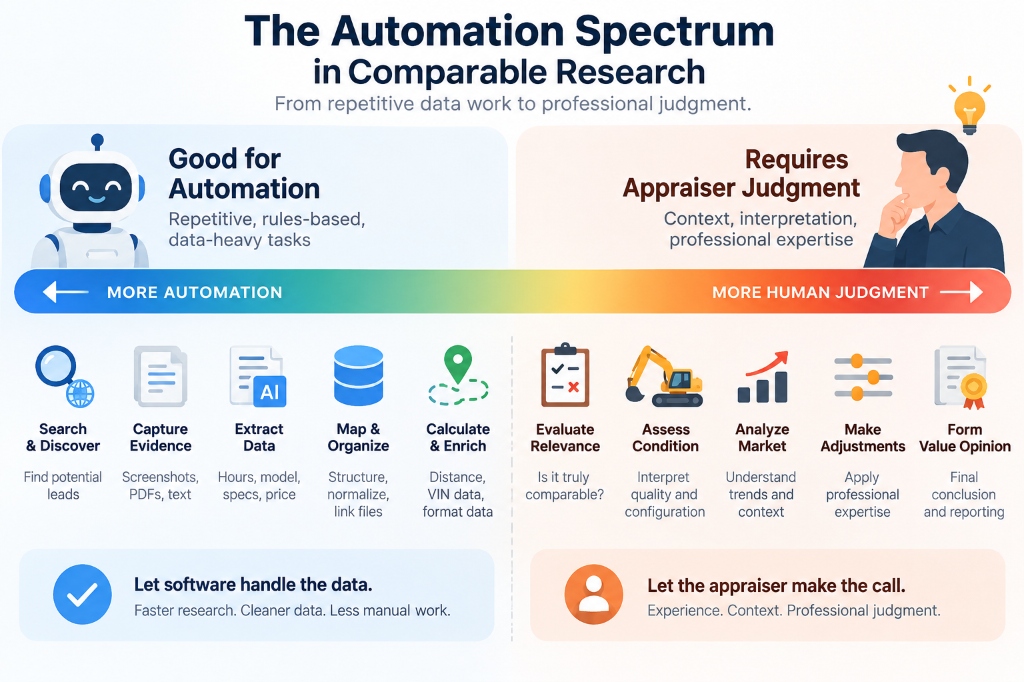
Comparable research contains two very different kinds of work.
There are mechanical tasks: searching, copying, capturing, extracting, calculating, organizing, and formatting information.
Then there are judgment tasks: deciding whether a sale is truly comparable, understanding differences between assets, interpreting market conditions, and determining how the evidence supports an opinion of value.
Those categories should not be treated the same.
The most useful role for appraisal automation is not to replace the appraiser. It is to handle the repetitive data-processing work surrounding the appraiser's analysis.
That distinction is central to how Price Chant approaches comparable research. The system is designed to automate tedious portions of the research process while keeping the appraiser responsible for professional decisions.
A Simple Rule for Appraisal Automation
Software is particularly good at operations that are:
- Repetitive
- Rules-based
- Data-heavy
- Easily verified
- Performed many times
- Based on clearly identifiable information
Human judgment becomes more important when the question involves:
- Context
- Relevance
- Condition
- Market interpretation
- Comparability
- Adjustments
- Reliability of evidence
- Final valuation conclusions
That boundary matters.
An AI system may be able to identify that two machines share the same model number. It cannot automatically assume that those machines are economically equivalent.
One may have substantially higher hours, different attachments, different condition, a different sale environment, or characteristics not visible in the listing.
"The software can organize the facts. The appraiser interprets what those facts mean."
1. Lead Discovery Is a Strong Candidate for Automation
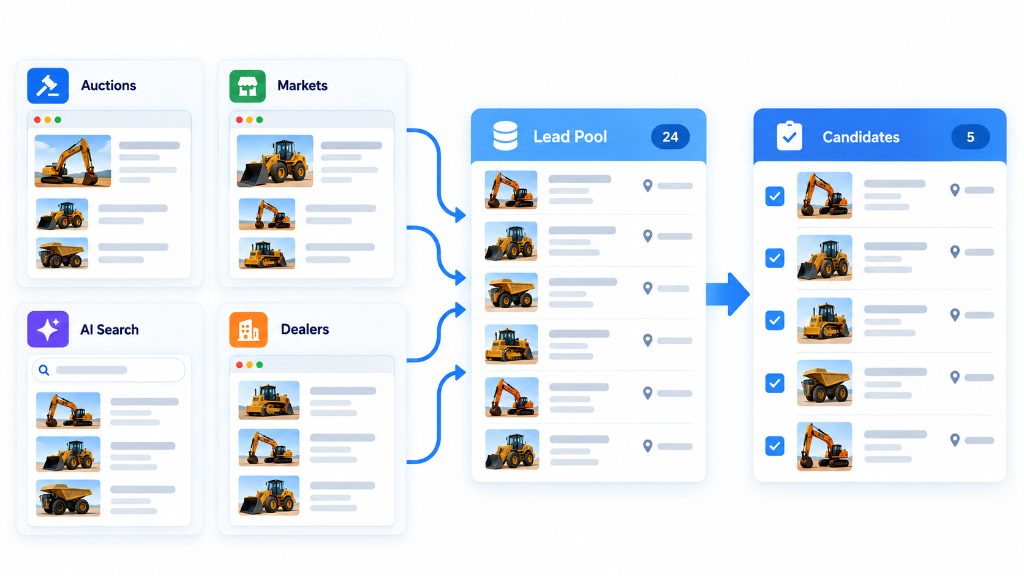
Comparable research often begins with discovery. The appraiser needs to locate possible market evidence across search engines, auction results, dealer sites, marketplaces, and other public sources.
This is an excellent place for automation because the goal is not yet to make a valuation decision. The goal is simply: find potentially relevant things to review.
Price Chant supports comparable lead generation through multiple research systems, including Google Search, ChatGPT web search, Gemini web search, and Perplexity. Those systems can help broaden the research surface and identify webpages that may contain useful market evidence.
Auction houses, equipment marketplaces, dealer listings, eBay, Craigslist, and other publicly available sources may all contribute potential leads depending on the assignment. But there is an important word in that sentence: potential.
Search automation should generate candidates. It should not automatically declare those candidates valid comparables.
What Software Can Do
- Generate search queries
- Search multiple sources
- Find similar makes and models
- Identify auction-result pages
- Surface marketplace listings
- Collect URLs
- Group potential leads by subject asset
These are discovery operations. They are scalable and relatively easy for an appraiser to verify.
What the Appraiser Still Does
The appraiser evaluates whether the result is actually relevant.
Price Chant intentionally separates a lead from a comp. A lead is a possible comparable; the appraiser reviews the source and determines whether characteristics such as make, model, year, configuration, condition, usage, location, specifications, and sale information make it useful market evidence.
That separation creates an important human-review checkpoint.
"AI discovers. The appraiser selects."
2. Webpage Evidence Capture Can Be Highly Automated
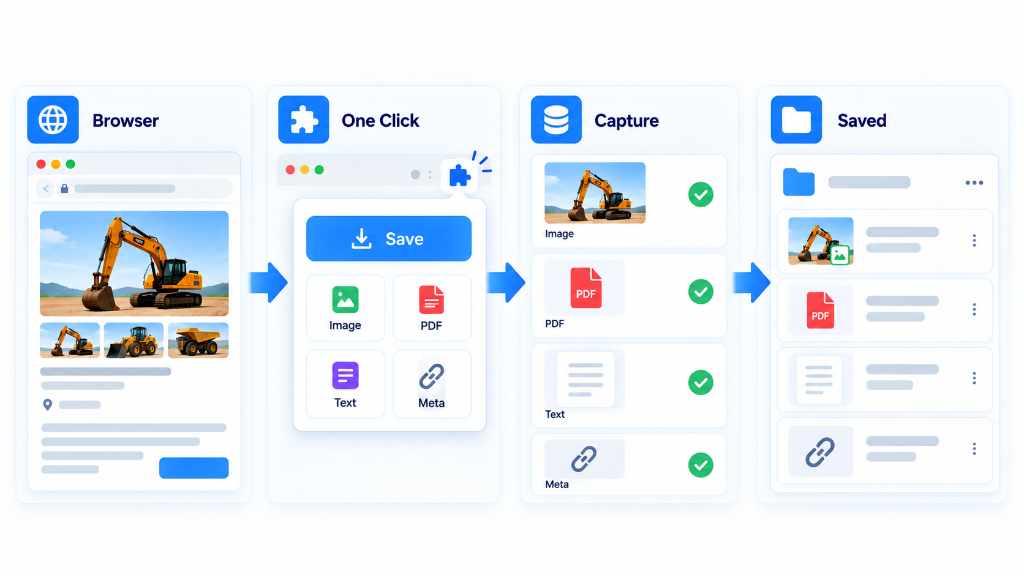
Once an appraiser decides that a listing is worth preserving, there is little analytical value in manually performing several documentation steps one by one.
Traditionally, that might involve:
- 1. Copying the URL.
- 2. Taking a screenshot.
- 3. Saving the screenshot.
- 4. Printing the page to PDF.
- 5. Naming the PDF.
- 6. Copying listing text.
- 7. Placing everything into the correct folder.
Those are mostly procedural actions. They do not require an opinion about value. That makes evidence capture another strong candidate for automation.
Price Chant's browser extension can capture supporting material directly from a comparable webpage, including a screenshot, PDF copy, webpage text, and source information. The appraiser still chooses the source. The software handles the documentation mechanics.
3. Comparable Data Extraction Is Well Suited to AI
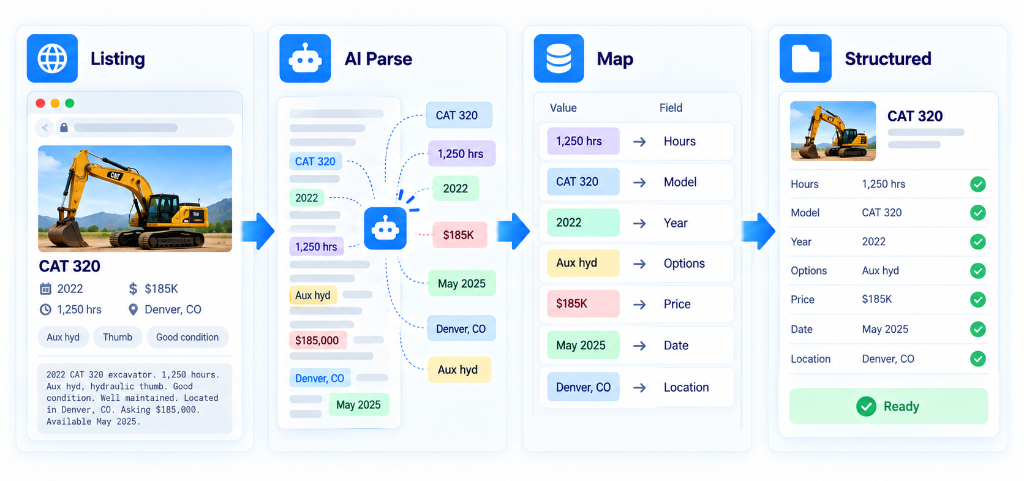
This is where artificial intelligence becomes especially useful. Equipment listings are generally written for people, not databases.
A page might contain:
"2021 wheel loader, 3,420 hours, enclosed cab, auxiliary hydraulics, quick coupler, 106-inch bucket."
An appraiser may want those details stored as separate fields:
| Field | Extracted Value |
|---|---|
| Year | 2021 |
| Hours | 3,420 |
| Cab | Enclosed |
| Hydraulics | Auxiliary |
| Coupler | Quick Coupler |
| Bucket | 106 in. |
Historically, someone has to read the page and manually transfer each value. Modern language models are well suited to identifying that information and converting unstructured listing text into structured data.
Price Chant uses AI to analyze captured webpage text and attempts to map information from the comparable into fields corresponding with the subject asset.
For example, the system might extract:
- Make
- Model
- Year
- VIN
- Hours
- Engine
- Fuel type
- Location
- Sale information
- Equipment characteristics
The key word, again, is attempts. Extraction should be treated as an assistive operation, not unquestioned truth. Price Chant therefore allows the appraiser to review extracted information rather than treating the AI output as the final authority.
Why AI Works Well Here
This task has several characteristics AI handles well: the source already contains the information, the model is being asked to identify and organize it, the output can be compared back against the source, and errors can be corrected.
That makes attribute extraction fundamentally different from asking AI to independently determine value. One is information processing. The other is professional interpretation.
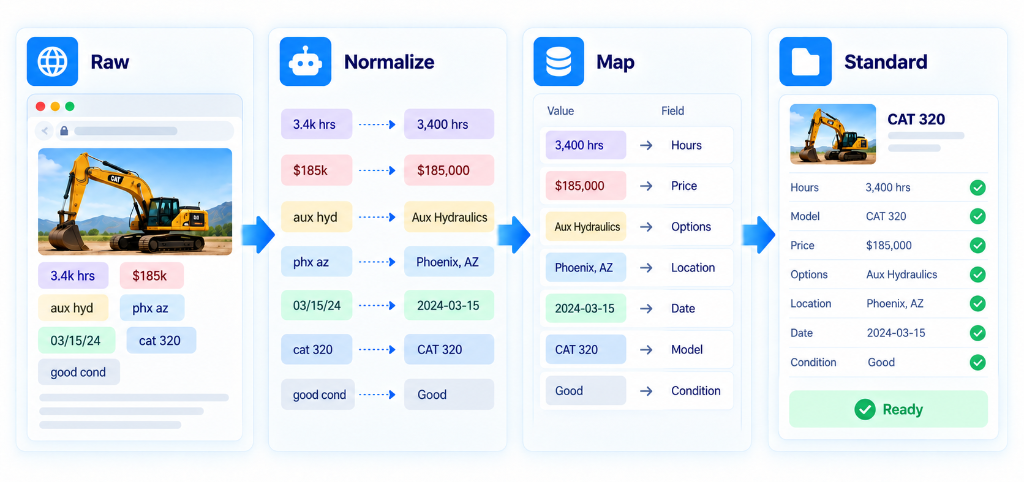
4. Field Mapping Can Be Automated
Extraction is only half the problem. The system also needs to understand where the information belongs.
Suppose the subject asset contains fields for: Manufacturer, Model, Year, Hours, Engine, Fuel type, GVWR, and Transmission. A comparable webpage may describe those same characteristics using different language or formats.
Software can help normalize those differences. For example:
- "3.4k hours" → Hours: 3,400
- "CAT" → Manufacturer: Caterpillar
- "Automatic trans." → Transmission: Automatic
- "Aux hyd." → Options: Auxiliary Hydraulics
This type of field mapping is a strong automation candidate because the appraiser does not need to manually decide which spreadsheet column should receive every obvious specification. The important control is review. Automation should make structured data easier to create—not make corrections impossible.
5. Asset Data Enrichment Can Be Automated
Sometimes useful characteristics are not explicitly stated on the source listing. A VIN, serial number, manufacturer record, or other identifier may allow additional information to be retrieved.
Price Chant can use VIN decoding to enrich vehicle-related information with characteristics such as manufacturer, engine, fuel type, vehicle class, GVWR class, manufacturing country, transmission, trim, and other VIN-derived specifications when available.
This is another good automation target. The system receives an identifier. It performs a defined lookup. It returns structured information. The appraiser can then determine whether that information is relevant to the comparison.
"Retrieving a characteristic can be automated. Deciding how much that characteristic matters cannot always be automated."
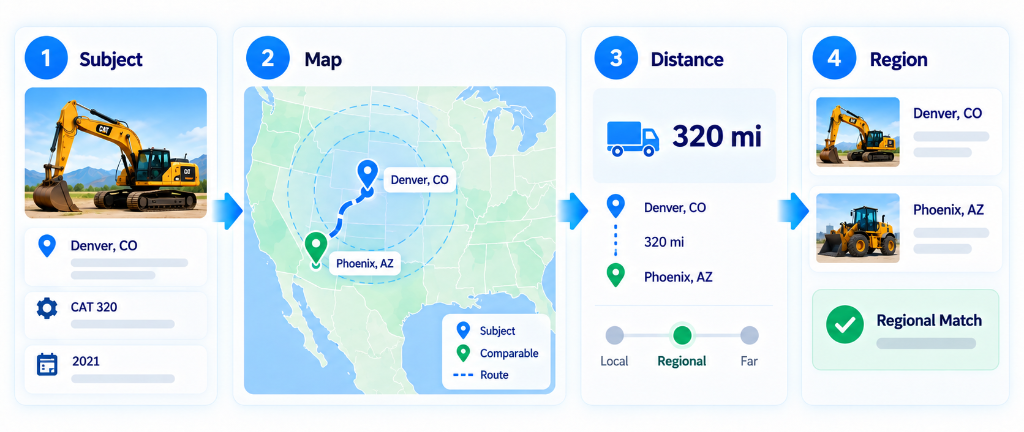
6. Distance Calculations Should Usually Be Automated
Suppose a subject asset is located in Sacramento and a potential comparable was sold in Phoenix. The arithmetic involved in determining geographic distance does not require appraisal judgment. Software can calculate it.
Price Chant calculates distance between a subject asset and comparable when sufficient location information is available and can display the geographic relationship visually. This is exactly the kind of task automation should remove from the appraiser's workload.
But software calculating "The comparable is approximately 750 miles away" is very different from software concluding "Therefore this comparable deserves a specific adjustment."
The first statement is a calculation. The second requires market interpretation. Automation should be much more confident about the first than the second.
7. Data Normalization and Organization Can Be Automated
Comparable research frequently produces inconsistent data. One source might list $185,000, another USD 185000, and another 185k. Dates may appear as 05/12/2026, May 12, 2026, or 2026-05-12. Hours may appear with commas, abbreviations, or descriptions.
Software can normalize these into consistent formats. It can also associate the resulting information with the correct: project, subject asset, comparable, source, screenshot, PDF, and extracted specifications.
Price Chant is built around keeping these relationships connected rather than allowing research materials to become independent files and records. The automation value here is largely structural: the system maintains relationships that would otherwise need to be maintained manually.
8. Export Preparation Can Be Automated
Once research is complete, comparable information often needs to move into another stage of the appraisal process. There is little reason to manually rebuild information that already exists in structured form.
Price Chant can export structured appraisal and comparable information into Excel and package supporting screenshots, images, and PDFs for download.
Export generation is another strong automation candidate because it follows predefined rules. The appraiser decides what evidence belongs in the project. The software packages that information.
What Should NOT Be Fully Automated?
The more consequential the decision becomes, the more important human review becomes. Several parts of comparable analysis should therefore remain under direct appraiser control.
Determining Whether an Asset Is Truly Comparable
Matching make and model is relatively easy. Evaluating comparability is not.
Consider two identical-model excavators. One has 1,200 hours, excellent maintenance history, enclosed cab, premium attachments, and strong regional demand. The other has 8,500 hours, visible wear, unknown maintenance, basic configuration, and different regional market conditions.
A search engine may classify them as highly similar. An appraiser may reasonably conclude that the differences are economically significant. That is why Price Chant generates leads rather than automatically turning search results into accepted comps.
Interpreting Condition
Condition is difficult to reduce to a single reliable automated signal. Listing language may be incomplete, seller descriptions may be subjective, photos may not show mechanical problems, and maintenance history may be missing. Two assets described as "good condition" may still differ materially.
AI can surface the available information. The appraiser evaluates its meaning and reliability.
Evaluating the Quality of the Transaction
A sale price alone does not explain the transaction. The appraiser may need to consider factors such as: auction environment, sale circumstances, included attachments, lot composition, buyer premiums, timing, market exposure, location, and whether the price reflects a completed transaction or merely an asking price.
These questions require context. Automation can gather evidence about the transaction. It should be cautious about interpreting the transaction on the appraiser's behalf.
Adjustments Require More Than Pattern Matching
It may eventually become possible for AI systems to assist extensively with adjustment analysis. But an adjustment is not simply a difference between two numbers.
Suppose the subject has 2,000 hours and a comparable has 5,000 hours. Software can calculate a 3,000-hour difference. That does not automatically answer: How much does that difference affect value in this particular market?
The answer depends on the asset class, age, market, equipment condition, demand, expected service life, transaction evidence, and other factors. Automation can provide the inputs. The appraiser develops the interpretation.
AI Should Make Evidence Easier to Inspect
A useful appraisal AI system should not make its work harder to verify. It should do the opposite.
If AI extracts "Hours: 3,468", the appraiser should be able to return to the captured source and verify where that number came from. If software identifies "Sale Price: $185,000", the supporting webpage, screenshot, PDF, or source information should remain available.
This is one reason evidence capture and AI extraction work well together. Price Chant captures the source documentation and then analyzes the captured webpage text, allowing structured comparable information to remain connected to supporting evidence. Automation becomes more useful when its output can be checked.
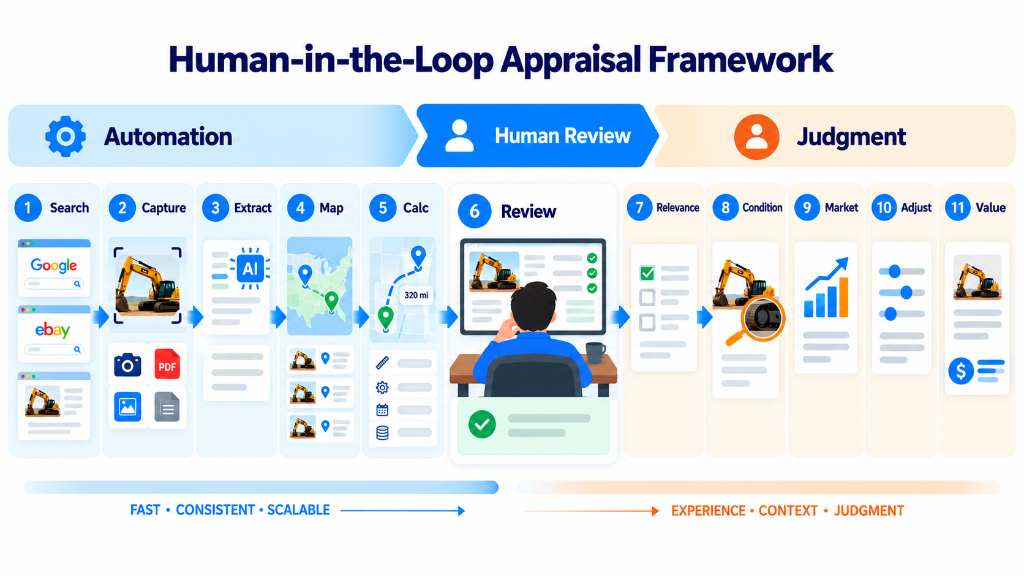
The Best Model Is Human-in-the-Loop Appraisal Research
The goal should not be a system where an appraiser clicks a button and receives an unexplained valuation. A more practical model looks like this:
- Software: Find possible evidence.
- Appraiser: Decide what deserves review.
- Software: Capture the evidence.
- Software: Extract relevant characteristics.
- Appraiser: Verify the information.
- Software: Calculate objective relationships such as distance.
- Appraiser: Interpret whether those differences matter.
- Software: Organize the selected evidence.
- Appraiser: Analyze the market and develop the valuation.
- Software: Prepare structured exports.
That is human-in-the-loop automation. The system performs the repetitive operations surrounding the analysis without taking ownership of the analysis itself.
Where Price Chant Fits
Price Chant is designed around this division of responsibilities. The platform can help automate or assist with:
- Lead Discovery: Search multiple systems for possible comparable-sale evidence.
- Evidence Capture: Preserve screenshots, PDFs, webpage text, and source information.
- AI Data Extraction: Identify comparable specifications from captured webpages.
- Field Mapping: Convert unstructured listing information into structured comparable fields.
- Asset Enrichment: Retrieve additional characteristics such as VIN-derived vehicle information.
- Geographic Analysis: Calculate subject-to-comp distance.
- Evidence Organization: Keep subject assets, comps, documentation, and data associated with one another.
- Structured Export: Produce Excel data and supporting-document packages.
These capabilities reflect Price Chant's broader purpose: helping appraisers spend less effort on collecting and organizing comparable evidence while keeping the appraiser responsible for the professional decisions.
Automation Should Remove Clerical Work, Not Professional Judgment
The most useful question is not: "Can AI perform appraisal research?"
A better question is: "Which parts of appraisal research benefit from machine execution, and which parts benefit from human interpretation?"
Search can be automated. Data extraction can be automated. Screenshots can be automated. PDF capture can be automated. Field mapping can be automated. Distance calculations can be automated. File organization can be automated. Exports can be automated.
But whether a comparable is appropriate, how differences affect market value, how much weight evidence deserves, and what conclusion the market supports remain fundamentally different questions. Those are the places where the appraiser adds the most value.
Modern appraisal software should therefore do more than automate tasks. It should create a cleaner boundary between work that requires judgment and work that merely consumes it.
"Let software process the evidence. Let the appraiser interpret the market."
Pull defensible comps, keep the reasoning tight, and ship the workfile faster.
Explore solutions