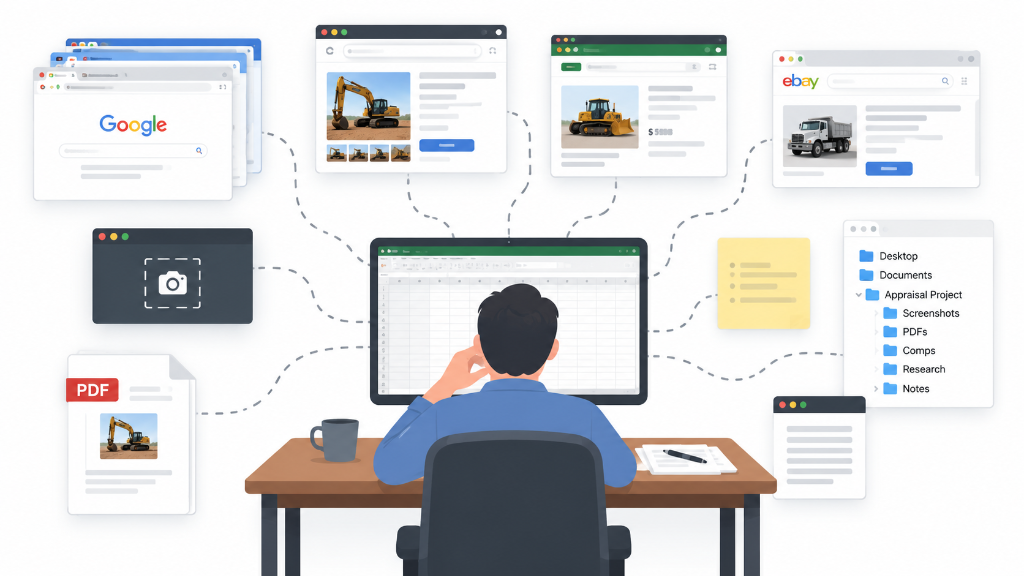
Comparable research often begins in a browser.
A search result leads to an auction page. That page leads to another listing. A promising sale gets opened in a new tab. A screenshot is taken. A PDF is saved. A URL is copied into a spreadsheet. Equipment specifications are entered manually. Supporting files are placed into a project folder.
None of these actions is unusual on its own.
The problem is that they often happen in completely different places.
By the time comparable research is complete, the evidence supporting a single appraisal assignment may be distributed across browser tabs, spreadsheets, local directories, screenshots, PDFs, bookmarks, notes, and downloaded files.
For equipment and personal property appraisers, modernizing comparable research is less about changing appraisal methodology and more about changing the architecture surrounding the research.
The appraisal judgment stays with the appraiser.
The information around that judgment can be much better connected.
The Traditional Comparable Research Workflow Is Fragmented by Design
Most traditional appraisal research workflows were never intentionally designed as a single process. They evolved from separate tools:
- The browser handles research.
- The spreadsheet handles structured data.
- The operating system handles files.
- A screenshot utility handles images.
- The browser or printer dialog creates PDFs.
- Bookmarks or notes preserve URLs.
- Folders preserve supporting documentation.
Each tool performs its own job reasonably well. The fragmentation appears when the appraiser has to keep the relationships between all of those pieces intact.
Price Chant was developed around this problem. Comparable research commonly requires an appraiser to move between search engines, auction platforms, marketplaces, screenshots, PDFs, specifications, distance research, and spreadsheets before reorganizing the results into an appraisal workfile.
The underlying issue is not necessarily the quality of any individual tool. It is that the workflow has no shared structure.
Follow One Comparable Through a Traditional Workflow
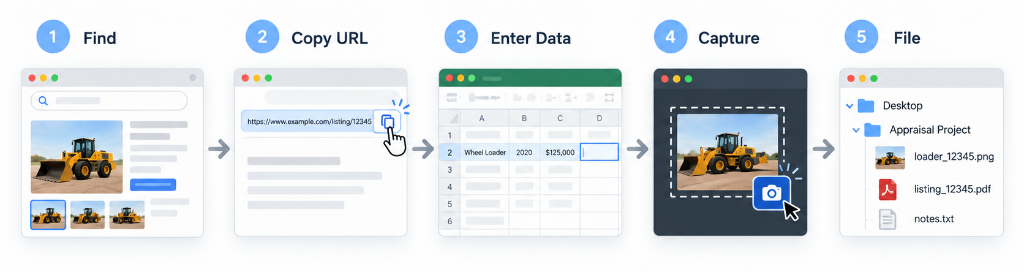
Consider a hypothetical piece of construction equipment being appraised. The subject asset is a 2020 wheel loader. The appraiser begins searching the market for comparable sales.
A potentially useful auction result appears. At that moment, the comparable exists as little more than a browser page. The appraiser now has to turn that page into documented market evidence.
- First, the appraiser reviews the listing and decides whether the machine appears sufficiently comparable to the subject.
- Then the listing URL may be copied into a spreadsheet.
- The sale price is entered.
- The make, model, year, hours, location, and other characteristics may be copied into separate columns.
- A screenshot may be captured to preserve what the webpage looked like.
- The page may also be printed or saved as a PDF.
- Images might be downloaded separately.
- The screenshot and PDF need filenames.
- Those files need a folder.
- The folder needs to correspond to the correct project.
- The spreadsheet row needs to correspond to the same comparable.
- The comparable then needs to remain associated with the correct subject asset.
Nothing about that process is particularly complicated. What makes it fragile is the number of relationships that must be maintained manually.
A Comparable Is More Than a Row in a Spreadsheet
One of the limitations of a spreadsheet-centered workflow is that a comparable can become reduced to a row of values. A row might contain:
| Field | Example |
|---|---|
| Make | Caterpillar |
| Model | 950M |
| Year | 2020 |
| Hours | 3,468 |
| Sale Price | $185,000 |
| Location | Phoenix, Arizona |
That information is useful, but it is not the entire body of evidence.
Behind those values is a source webpage. That webpage may contain photographs, seller information, equipment descriptions, sale terms, condition details, specifications, auction dates, location information, and other context.
The spreadsheet records the structured portion. The appraisal workfile needs the connection between the structured data and the evidence supporting it.
The Real Organizational Challenge Is Maintaining Relationships
A strong comparable research system needs to preserve several relationships at the same time:
- The subject needs to stay connected to the research performed for it.
- Potential leads need to remain distinguishable from comps actually selected by the appraiser.
- Selected comps need to remain connected to their original sources.
- Extracted specifications need to remain connected to the evidence from which they were obtained.
- Screenshots and PDFs need to remain connected to the correct comparable.
- And the resulting comparable needs to remain connected to the correct subject.
This is why Price Chant organizes the workflow around a continuous relationship:
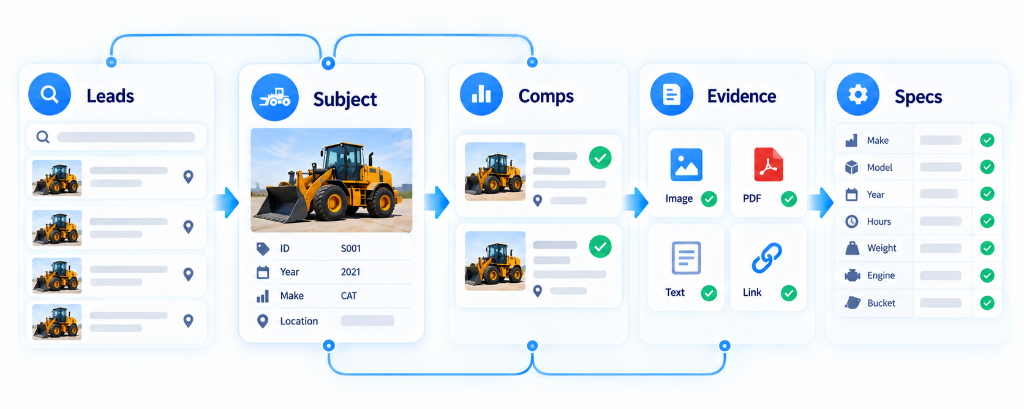
That model is fundamentally different from treating comparable research as a collection of unrelated files.
Search Results Should Not Automatically Become Comps
A modern workflow should also preserve an important distinction between discovery and selection.
- Search engines can surface potential market evidence.
- AI-assisted research tools can help discover additional listings.
- Auction databases can expose completed sales.
- Marketplaces can reveal similar equipment.
But a search result is not automatically a valid comparable.
Price Chant refers to these potential results as leads. A lead becomes a comp only after the appraiser reviews it and decides that it is useful market evidence for the subject asset.
This separation matters because it mirrors how appraisal research actually works.
"Software can expand the research surface. The appraiser still determines relevance."
Modern Comparable Research Starts With the Subject
A structured workflow should begin with the asset being appraised rather than with an empty browser tab.
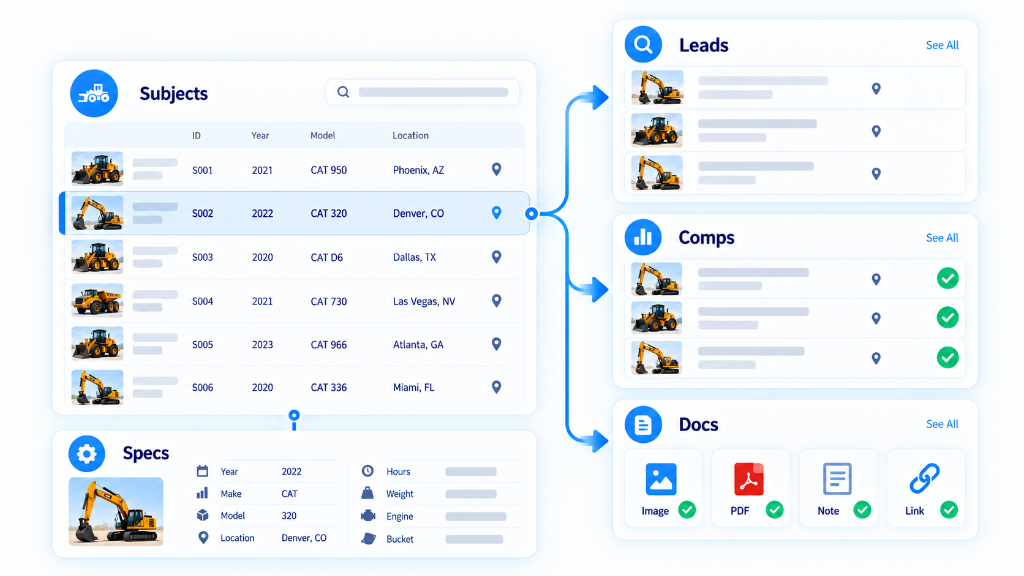
In Price Chant, subject assets can be imported from a CSV or Excel file and organized within an appraisal project. Different assignments can contain different fields, such as make, model, year, serial number, VIN, hours, mileage, location, condition, manufacturer, engine, fuel type, and other asset-specific characteristics.
This creates an important architectural difference. Instead of conducting market research first and trying to organize it later, the research begins from an existing subject record.
- The subject becomes the anchor.
- Potential leads belong to that subject.
- Selected comps belong to that subject.
- Evidence belongs to those comps.
The workfile grows outward from the appraisal project rather than being assembled backward from a collection of downloaded files.
Multi-Source Research Should Feed the Same Workflow
Comparable sales rarely live in one database. Depending on the asset, relevant evidence may come from auction houses, equipment marketplaces, dealer listings, eBay, Craigslist, private-party listings, or other publicly available market sources. Price Chant also supports lead discovery using multiple search systems, including Google Search, ChatGPT web search, Gemini web search, and Perplexity.
The important architectural concept is not simply having more search options. It is having those search options feed the same research process.
Without a unified workflow, every new source can create another organizational branch:
- One auction site may produce a PDF.
- Another may require a screenshot.
- A marketplace listing may provide detailed specifications.
- A dealer page may provide photographs but limited sale information.
The sources differ. The workfile still needs a consistent structure.
Evidence Capture Should Happen at the Source
A common weakness in fragmented workflows appears between discovering a comparable and documenting it. The appraiser finds the evidence in one environment and preserves it in another. That gap creates opportunities for files to be misplaced, mislabeled, or detached from the corresponding comp.
A more connected approach captures the evidence while the appraiser is still viewing the source.
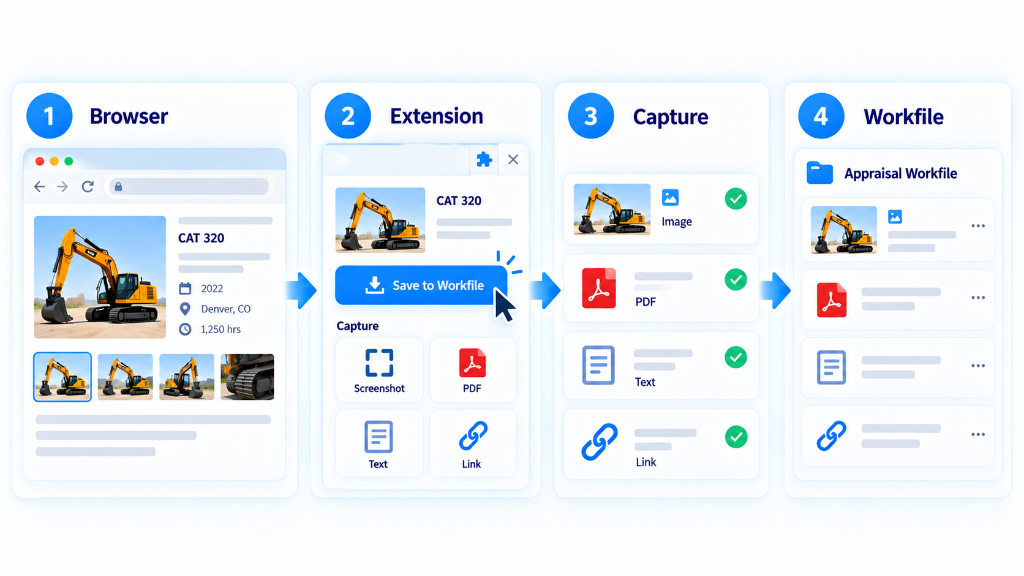
Price Chant's browser extension is designed around this point in the workflow. When the appraiser chooses to save a comp, the system can capture a screenshot of the webpage, a PDF copy, the webpage's textual content, and source information associated with the comparable.
The key architectural improvement is not merely automatic screenshot capture. It is that the evidence enters the same project structure as the comparable. The source and the record are no longer separate organizational problems.
Unstructured Webpages Can Become Structured Comparable Data
Webpages are designed for people to read. Appraisal analysis often requires information to be structured.
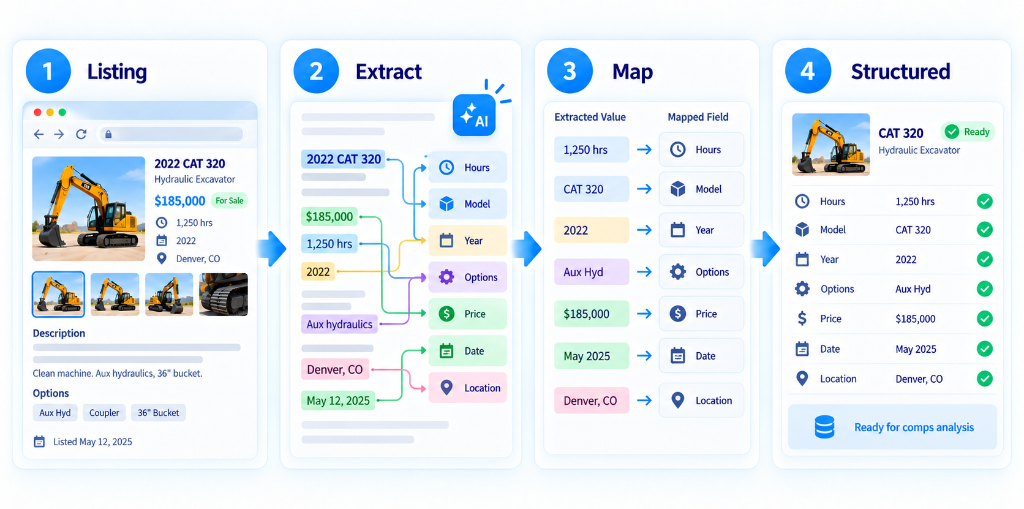
An auction listing might describe the year in a headline, the hours in a specifications table, the location near the seller information, and the engine details farther down the page. A traditional workflow requires someone to identify those values and move them into the appropriate spreadsheet columns.
A connected system can treat the captured webpage as a data source. After a comparable is captured, Price Chant can use AI to identify characteristics on the page and attempt to map them to the same fields used by the subject asset. The appraiser can then review the extracted data rather than relying on the software to make the appraisal judgment.
The Workfile Becomes a Product of the Research Process
In a fragmented workflow, workfile organization frequently happens after the research: research first, organize later. A connected workflow changes that sequence: the workfile is created as the research happens.
- When a comparable is selected, its source is preserved.
- When evidence is captured, it stays associated with the comp.
- When specifications are extracted, they remain associated with the evidence.
- When location information is available, geographic relationships can be evaluated as another characteristic of the comp.
By the end of the assignment, the appraiser is not reconstructing the research process. The structure already exists.
From File Management to Evidence Management
There is an important difference between managing files and managing evidence:
- File management asks: Where is the PDF? → Evidence management asks: Which subject does this PDF support?
- File management asks: Where did I save the screenshot? → Evidence management asks: Which comparable did this screenshot document?
- File management asks: Where is the spreadsheet row? → Evidence management asks: What source supports the values in this row?
That shift is one of the clearest distinctions between a traditional appraisal research workflow and a modern one.
Folders are still useful. Spreadsheets are still useful. PDFs are still useful. The improvement comes from preserving the relationships between them.
Export Should Be the End of the Workflow, Not the Beginning of Organization
Once comparable research is complete, the information still needs to be usable outside the research platform.
Price Chant allows structured appraisal and comparable data to be exported into Excel. Supporting material such as screenshots, images, and PDFs can also be downloaded together as an organized package for use in report preparation or retention in the appraisal workfile.
That means export becomes the final step in an already structured process. The alternative is familiar: open the downloads folder, find the screenshots, rename the PDFs, match them to spreadsheet rows, move everything into project directories, and check that nothing is missing.
A structured workflow moves that organizational responsibility earlier in the process, where the relationships are easier to preserve.
What Does a Modern Comparable Research Workflow Look Like?
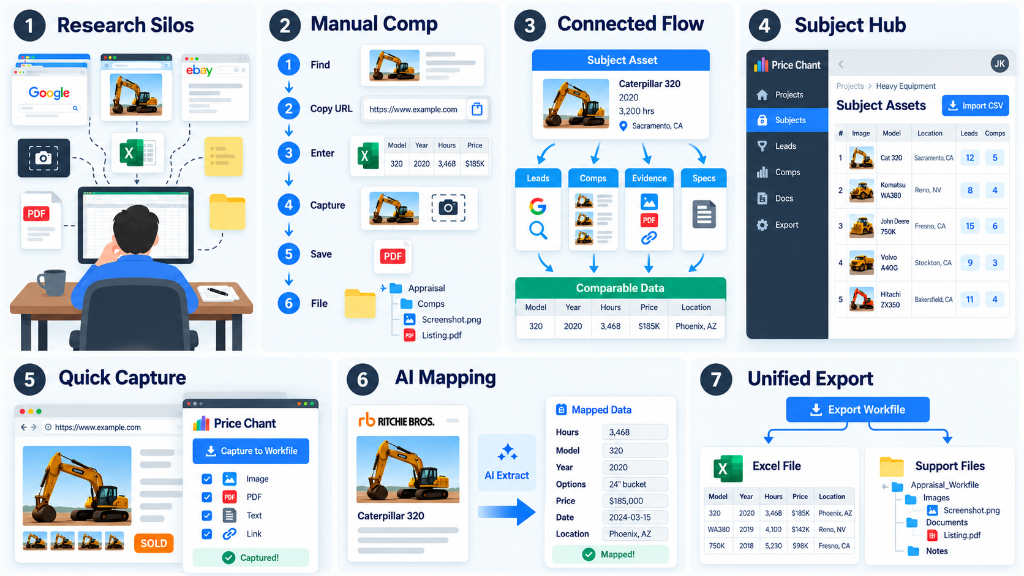
The traditional model can be summarized as a collection of disconnected tools:
A modern workflow is better represented as a connected research pipeline:
Price Chant is designed around the second model. It should be understood as an appraisal research workflow and evidence-management system, not simply a comparable search engine. Search is only the beginning; the broader purpose is to connect subject data, research, leads, appraiser selection, evidence, extracted comparable data, analysis, documentation, and export.
Modernizing Appraisal Research Does Not Mean Automating Appraisal Judgment
A connected workflow should not decide what the appraisal conclusion should be. That remains the responsibility of the appraiser. The opportunity is to improve everything surrounding that decision:
- Software can help organize subjects.
- It can surface research leads.
- It can preserve webpages.
- It can structure specifications.
- It can maintain evidence.
- It can calculate distances.
- It can prepare exports.
But the appraiser still evaluates whether the comparable is meaningful and how that market evidence should influence the valuation. That distinction allows appraisal technology to improve the workflow without replacing professional judgment.
Build the Workfile While You Research
The biggest difference between traditional and modern comparable research is not the number of tools involved. It is whether those tools produce one connected body of evidence.
When subject assets, research leads, selected comps, source documentation, structured data, and exports remain connected throughout the assignment, the appraisal workfile becomes easier to understand and maintain.
Instead of reconstructing the story of the research afterward, the system preserves that story as the work is performed. That is the architectural idea behind Price Chant.
"The browser can remain where research begins. It no longer has to be where organization ends."
Price Chant connects comparable discovery, evidence capture, structured comp data, subject-to-comp relationships, and export within one appraisal research workflow.
Pull defensible comps, keep the reasoning tight, and ship the workfile faster.
Explore solutions